Get Pleasanton roofing expertise grounded in ASCE 7 wind exposure, NOAA Atlas 14 rainfall, and CRC/Title 24 compliance. We carry out laser-level structural checks, infrared/dye leak mapping, and moisture verification (ASTM D7877). Look forward to ember-resistant edges (CBC 7A), upgraded underlayments, and corrosion‑resistant fasteners. You'll receive binary repair/replace decisions, CSI-coded estimates, HOA‑aligned specs, and OSHA-compliant work. Materials are tested to UL 790, ASTM D3161/D7158, and UL 580/1897. Discover how our code-focused process safeguards your home year-round.
Critical Insights
- Local Pleasanton experts knowledgeable about hot-dry summers, wet winters, Diablo winds, and Chapter 7A ember-resistant boundaries.
- Thorough inspections: structural load configurations, fastening system integrity, water intrusion mapping, infrared, colorant tracing, and hose integrity testing with photographically documented results.
- Regulation-compliant reports: referenced CRC standards, acceptance and rejection standards, seal-stamped remarks, priority-ordered tasks, and service life projection analysis.
- Data-backed repair vs. replacement: deck moisture (ASTM D7877), wind uplift capacity ratings, fastening pull-out capacity, and continuous flashing integrity.
- Permitting and HOA coordination handled; materials selected based on climate conditions, ventilation calculated per IRC R806, and Title 24 energy requirements addressed.
Why Local Experience Is Essential for Pleasanton Roof Systems
As Pleasanton resides in a microclimate zone with arid summers, cool-wet winters, and occasional Diablo winds, local roofing expertise ensures specifications align with real-world conditions and failure modes. You need experts who transform wind exposure (ASCE 7), rainfall intensity (NOAA Atlas 14), and heat cycles into materials, fastening, and flashing details that meet plan check and perform in service.
You'll receive support from professionals experienced with area codes, historic preservation regulations, and HOA standards, so installations comply with setbacks, sightlines, and approved color/texture palettes. Local contractor networking speeds up supply, confirms installers, and guarantees warranty-compliant sequencing. Teams concentrate on climate adaptation: upgraded underlayments, vented assemblies to control dew-point, ember-resistant edges per Chapter 7A, and corrosion-resistant fasteners. Results: fewer callbacks, stable lifecycle costs, and verified compliance.
Professional Roof Evaluation Services
You'll get a detailed structural assessment that evaluates load paths, fastener integrity, membrane condition, and substrate deflection with image-documented findings. We employ leak detection methods using moisture meters, infrared thermography, tracer dyes, and controlled hose testing to pinpoint intrusion points with timestamped data. You receive maintenance and reporting that outline prioritized repairs, service intervals, and code-referenced documentation for compliance and budgeting.
Detailed Building Analysis
Although all roofs age in different ways, a thorough structural assessment applies a standardized, test-driven process to verify load paths, member integrity, and code compliance. We provide quantified findings: we document truss geometry, measure deflection, and calculate tributary areas to validate load bearing integrity against ASCE 7 design loads. We examine rafters, ridge beams, sheathing nailing patterns, and connection hardware, cataloging fastener spacing and uplift resistance per manufacturer specs.
We analyze the relationship between framing plumbness and diaphragm stiffness with markers of foundation settlement, using laser levels, crack gauges, and moisture-adjusted density readings. We provide photo-verified anomalies, section modulus assessments for overstress, and metal connector corrosion ratings. We also review attic ventilation ratios, insulation weight impacts, and snow/wind load histories. Deliverables include pass/fail criteria, corrective priorities, and stamped compliance notes.
Methods for Leak Detection
Long before water shows on ceilings, we implement a layered leak-detection protocol that isolates sources, validates pathways, and quantifies risk. You get a structured workflow: baseline moisture mapping, anomaly confirmation, and source pinpointing. We initiate with calibrated thermal imaging to reveal temperature differentials from evaporative cooling, flagging subsurface moisture beneath membranes, shingles, and flashings. Following this, we use capacitance and pin-type meters to verify saturation levels by material class.
We subsequently utilize acoustic sensors to identify micro-drips and capillary flow within cavities, filtering ambient noise to locate path convergence. Dye testing with UV additives validates ingress points at penetrations, seams, and terminations. Finally, controlled hose testing isolates assemblies in zones, documenting flow onset time, rate, and spread to link cause, path, and entry with high confidence.
Maintenance and Documentation
Once inspection data is collected, we move into maintenance and reporting with a defined protocol that transforms findings into actionable work orders. You obtain a prioritized task list with severity, location, and component IDs connected to photos and sensor logs. We codify fixes as tickets with scope, materials, labor hours, and acceptance criteria, then schedule seasonal inspections to ensure remediation and prevent regression.
Our assessments follow a consistent schema: defect type, root cause hypothesis, recommended remedy, and risk score. You get timestamps, technician signatures, and chain-of-custody for samples. Record keeping is standardized: all artifacts reside in a searchable repository with version control, audit trails, and change logs. Metrics-MTBF, leak recurrence, and moisture deltas-drive modifications to your maintenance plan.
Storm Damage Assessments and Insurance Guidance
Start by triaging storm consequences with a structured roof assessment: document hail impacts, wind-lifted shingles, creased tabs, punctured underlayment, displaced flashing, and granule loss using geotagged photos and time stamps. Capture near and distant documentation photos, include slope, elevation, and compass orientations, and log moisture readings at penetrations. Deploy an emergency tarp according to OSHA fall protection and City of Pleasanton regulations; note dimensions and fastener spacing.
Submit insurance claims inside policy notice windows; attach invoices, your inspection log, and ASTM/ICC references for damage criteria. Synchronize adjuster interaction to your evidence: schedule ladder assists, share your damage map, and request line-item scopes (Xactimate estimating or equivalent). Track payout timelines, reserve supplements for hidden damage, and apply deductible strategies legally-never inflate line items or omit depreciation details.
System and Material Options for Roofing
You'll compare asphalt shingles to metal panels using longevity, wind uplift ratings (ASTM D3161/E1592), fire classifications (UL 790), and local energy code impacts. You'll also size ventilation to comply with IRC R806 (net free area and balanced intake/exhaust) and integrate it with insulation R-values per California Title 24. With these standards, you can model thermal performance, control condensation risk, and align material selection with life-cycle cost and maintenance intervals.
Metal versus Asphalt
While both systems can deliver durable weatherproofing in Pleasanton's microclimate, asphalt shingles and standing-seam metal diverge considerably in performance, lifecycle, and total cost of ownership. You'll typically see asphalt installed to ASTM D3462 with Class A fire ratings and optional Class H wind resistance; plan for 20-30 years of service if installed per ICC-ES reports. Metal panels (24-26 ga) with concealed fasteners meet UL 580/1897 wind uplift and Class A fire, often surpassing 50 years.
The high solar reflectance index and cool-pigment coatings enhance energy efficiency and minimize thermal cycling. Asphalt offers better intrinsic sound insulation, however metal with solid decking and underlayment reduces the gap. Initial cost benefits asphalt; lifecycle cost often favors metal due to fewer replacements and lower maintenance.
Ventilation and Insulation
Choosing metal or asphalt determines the external layer, but roof efficiency in Pleasanton relies on how you specify ventilation read more and insulation as a system. You'll comply with code and increase roof longevity by balancing intake and exhaust. Target net free area for attic ventilation at 1:150 (or alternatively 1:300 with a Class I/II vapor retarder), divided approximately 50/50 between soffit intake and ridge exhaust. Use channeled vents to block wind-driven rain and preserve 1-inch clear air paths above insulation.
Specify R-38 to R-49 ceiling insulation; seal penetrations prior to adding batts or blown cellulose. In the mixed-dry climate of Pleasanton, prefer vented attics; if unvented, install code-approved spray foam at the roof deck. For crawlspace insulation, air-seal and insulate rim joists, address ground vapor, and maintain conditioned airflow.
Repair vs. Replacement: How We Assist You in Deciding
As every roofing system ages distinctively, our inspectors measure performance levels before advising on repair or replacement. We collect measurable data: slope, deck moisture content (%, ASTM D7877), shingle granule loss (%), fastener pull-out strength (lbf), membrane seam integrity, flashing continuity, and leak mapping via infrared and tracer dye. You receive a binary decision matrix aligned to California Residential Code and manufacturer specifications.
We calculate remaining service life using defect density and local weather loads, then run a cost benefit analysis over the roof's life cycle. If targeted repairs can recover watertightness and code compliance with ≥3 years projected service, we define repair scope and materials. If systemic failures exist- substrate deterioration, widespread UV embrittlement, or ventilation-related curl—we advise replacement to eliminate recurrent risk and sunk maintenance costs.
Clear Cost Assessments and Project Deadlines
Look for line-item estimates and Gantt-based schedules that you can audit. You'll see project scope, quantities, unit costs, and labor hours linked to CSI codes, so upfront pricing is confirmable. We provide assumptions, exclusions, and change-order thresholds, eliminating scope creep. Each task includes predecessors, resource loading, and buffer logic, producing realistic timelines you can trace back to weather data and crew availability.
We document every revision with timestamps, preserve a versioned cost log, and generate variance reports (baseline compared to current). You'll receive start/finish dates, critical path visibility, and float calculations, so schedule risk is explicit. We match payment milestones to earned value, not promises, and provide progress updates with photo evidence. If unknowns emerge, we issue a quantified impact analysis before you authorize any adjustments.
Safety Protocols and Quality Guarantees
While crews mobilize, we implement OSHA 29 CFR 1926 Subpart M fall protection, ANSI/ASSE Z359 tie-off standards, and ASTM D226/D7158 material specs to minimize risk and verify compliance. You'll see guardrails, warning lines, and 100% tie-off with inspected anchors rated per Z359. Worker PPE includes hard hats, cut-resistant gloves, ANSI Z87.1 eye protection, and ASTM F2413 boots; respirators are implemented per 1910.134 when adhesives or particulates warrant.
We maintain documentation of pre-task plans, ladder inspections to 1926.1053, and hot-work permits with fire watch. Fastener configurations adhere to manufacturer ESRs and FM 4470 approvals; underlayments comply with ASTM D226 and wind ratings per D7158 classification.
Our craftsmanship warranty links to code-conforming installation and confirmed pull-out and torque tests. We provide written coverage duration terms, transferability, and claim response SLAs.
Maintenance Plans to Prolong Roof Life Expectancy
With safety protocols and craftsmanship standards in place, a structured maintenance schedule maintains performance and warranty value. You'll execute seasonal inspections keyed to Pleasanton's precipitation and UV cycles: spring/fall assessments for wind uplift, fastener torque, sealant elasticity (ASTM D4586/D793), and membrane punctures; summer IR scans to flag latent moisture; winter inspections for flashing movement and underlayment exposure. Conduct gutter maintenance quarterly: clear debris, check slope (1/16-1/8 in./ft), seal seams, and ensure downspout discharge ≥5 ft from foundations to avoid fascia rot and ice dams.
Catalog each task with dated photographs, readings (moisture gauge %MC), and a deficiency list organized by risk. Replace compromised shingles, secure popped fasteners, reseal penetrations, and prune overhanging tree limbs. Set maintenance intervals by roof age, material type, and exposure level.
Installation Day and Beyond: What to Expect
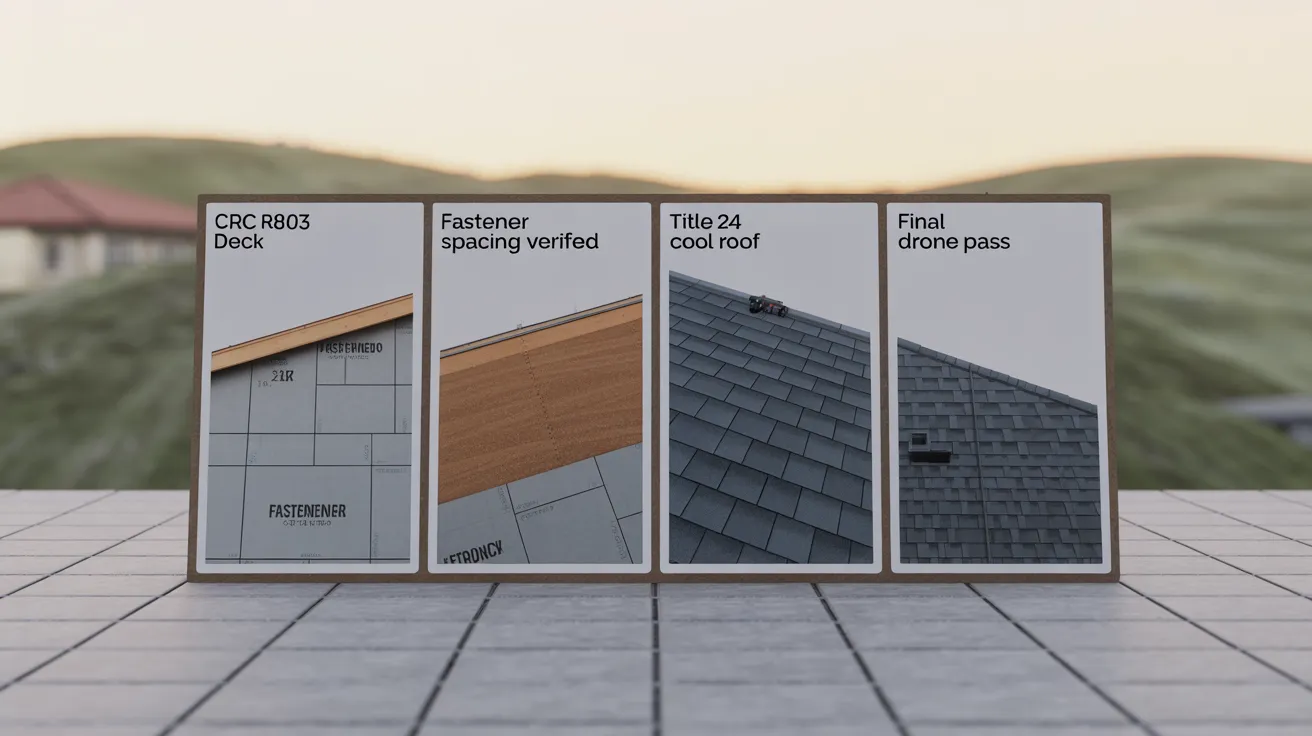
Before the team shows up, you'll see a pre-start checklist: permit posted, utility lines located, staging area taped, and weather window verified (≤20% precip probability, sustained winds <20 mph). Anticipate neighbor introductions to coordinate parking, noise windows, and debris control. Upon arrival, the crew photographs existing conditions, sets fall protection per OSHA 1926.501, and installs perimeter tarps and magnetic mats. Removal progresses by slope; decking is examined and substituted to meet CRC R803. Underlayment layers, flashings, and penetration points follow manufacturer specs and Title 24 cool-roof requirements where applicable.
You'll review and approve ventilation numbers, fastener patterns, and shingle batch numbers. Daily QC logs document nailing depth and valley specifications. Final walkthrough incorporates drone imagery, warranty registration, and post installation cleaning: magnet sweep, gutter flushing, and driveway blow-off.
Popular Questions
Do You Provide Financing or Payment Plans for Roofing Work?
Absolutely-you can leverage Flexible Financing with reliable Monthly Payments. You choose APR, term length, and down payment; we create an amortization schedule and itemized cost breakdown. We include soft-credit prequalification, no prepayment penalties, and ACH or card autopay. Available terms: 0% promo periods, fixed-rate terms (spanning 12-120 months), and staged draws matched with project milestones. We'll validate identity, income, and project scope, then issue a detailed, code-style contract with exact payment dates.
Can Old Roofing Materials Be Disposed of in an Eco-Friendly Manner?
Indeed. You can establish eco-friendly disposal using material sorting, recycling programs, and sustainable disposal streams. Separate asphalt shingles for shingle-to-pavement recycling, metals for smelting, wood for biomass, and plastics for HDPE recycling. Specify haulers with documented chain-of-custody and landfill diversion reports. Mandate LEED-compliant practices, contaminated material isolation, and dust/particulate controls. Employ on-site containers with labeled streams, confirm processor certifications, and audit diversion rates (above 75%). Capture data in disposal manifests for compliance.
Are You Capable of Coordinating With Solar Installers During Roofing Work?
Indeed. You can enable Solar coordination by synchronizing tear-off, dry-in, and underlayment milestones with Installer scheduling windows. Provide array layout, conduit paths, rafter maps, and attachment specs in a joint pre-construction meeting. You'll pre-place flashed standoffs, dedicated homeruns, and roof penetrations per NEC/IBC. Sequence: dry-in → standoff install → waterproofing → final roofing → PV mounting. Use shared Gantt updates, change-order gates, and photo QA to preserve code compliance and reduce rework.
What's Your Approach to Pets and Yard Access During Projects?
We require secure access to your yard and proper pet control. Before we begin, you'll confine indoor pets to secured rooms and move outdoor pets out of access paths and debris zones. Please provide gate codes/locks, note sprinkler lines, and identify fragile landscaping. We place materials on hardscape only, install temporary barriers as needed, and log gate status daily. You must confirm waste bin placement and cleanup timeframes. Deviations require written approval. Non-adherence may pause work for safety.
How Do You Address Surprise Structure-Related Issues Identified During the Project?
When discoveries occur, you adjust swiftly. Plan carefully, execute precisely: you trigger a structured workflow-immediate structural assessment, document findings (visual records, load-path notes), and quantify risk. You pause affected scopes, execute repair prioritization by safety, weatherproofing, and critical-path impact. You issue a change order with costs, code citations, and timeline adjustments. You implement temporary measures (bracing, tarps), procure approvals/permits as required, then implement fixes per IRC/IBC specs and manufacturer details. You verify with reinspection.
Key Takeaways
You've observed how local insight, rigorous inspections, and data-backed selections converge like validated code deploying cleanly to production. When storms occur, we'll triage, document, and optimize your claim path. You'll compare material specs, life-cycle costs, and failure modes-then choose repair or replacement with confidence. Expect straightforward estimates, predictable timelines, OSHA-aligned safety, and workmanship guarantees. With scheduled maintenance, your roof's uptime remains high. On install day, every fastener, flashing, and seam aligns-tight, validated, and ready for years of dependable service.